An air conditioner is never silent. There is the soft hum of the air handler, the rush of air through the vents and the steady whir of the fan outside. You stop hearing those within a week of moving in.
So when something new shows up, you notice it straight away. A buzz that was not there yesterday. A rattle every time the system starts. A squeal from the closet in the hallway.
The good news is that most AC noises are specific. Different failures make different sounds, and if you can describe the sound and where it is coming from, you have already done half of the diagnosis. Some of them are nothing to worry about. A few of them mean you should turn the system off right now. Here is how to tell which is which.
First, a few noises that are normal
Before anything else, it is worth knowing what you can ignore.
A single click when the system starts and another when it stops is the contactor or a relay switching on and off. That is supposed to happen.
A low, steady hum from the indoor unit while it runs is the blower motor doing its job. Air moving through the return grille makes a gentle rushing sound, and it gets a little louder when the filter is new and clean.
A few pops or ticks from the ductwork for the first minute or two of a cycle is usually sheet metal expanding and contracting as cold air hits it after the attic has warmed it all afternoon. In a Florida attic, that is common.
If what you are hearing is one of those, you can relax. If it is not, read on.
Buzzing or humming from the outdoor unit
This is the noise we get asked about most in the summer here, and it usually means an electrical part is struggling.
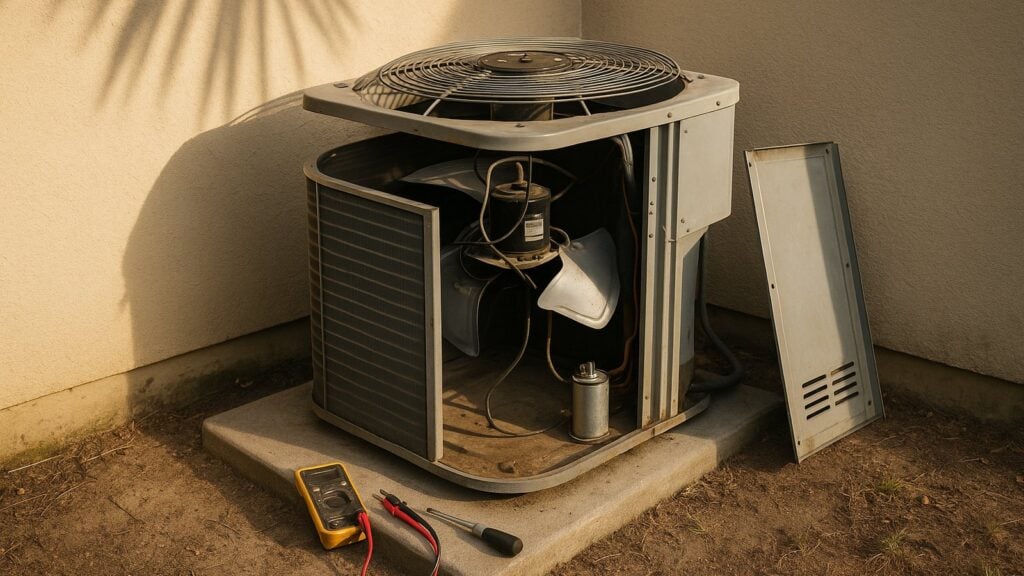
If the outdoor unit hums or buzzes but the fan on top is not spinning, the most common cause by far is a capacitor. It is a small cylinder that gives the fan motor and the compressor the kick they need to start. Capacitors wear out, and heat speeds that up. A unit that sits in full Florida sun and runs for most of the year works its capacitor hard, so this is one of the most frequent failures we see.
A buzz can also come from the contactor, the switch that sends power to the outdoor unit. Its contacts pit and burn over time, and a worn one can chatter or buzz instead of closing cleanly.
Turn the system off at the thermostat if the outdoor unit is humming but the fan is not moving. A compressor that keeps trying to start without help will overheat, and that can turn a small part into a very expensive one. And please do not open the panel to look. A capacitor can hold an electrical charge even with the power off.
Clicking that keeps repeating
One click at start and one at stop is normal. Clicking that repeats over and over, with the system trying to start and never quite getting going, is not.
That pattern usually points at the electrical side: a failing contactor, a problem with the thermostat or its wiring, or a control board that is not sending a clean signal. After a summer storm, a power surge is a common culprit. If the clicking started right after the power flickered, have a look at our guide on how to reset your AC after a power outage before you do anything else, because sometimes the system is simply waiting on a safety delay.
Rattling
Rattling is usually the least serious noise on this list, and it is often mechanical rather than electrical.
Outside, the likely causes are a loose service panel, a loose screw on the cabinet, or debris that has worked its way into the unit. Here that can mean twigs, oak leaves, pine straw or a summer’s worth of lovebugs packed against the coil. Inside, a loose panel on the air handler or a loose piece of ductwork can rattle every time the blower starts.
A rattle that gets louder over a few weeks, or turns into a knock, is worth having looked at, because it can also be a fan blade or a motor mount working loose.
Squealing or screeching
A high pitched squeal usually means a motor is in trouble.
Most home systems today use motors that drive the fan directly, so the usual source of a squeal is a motor bearing that has started to fail, either in the blower indoors or the fan motor outside. It tends to be worst right at start up and ease off once the motor is running.
There is one sound in this family that deserves more urgency. A loud screaming or shrieking sound from the outdoor unit can mean pressure is building up inside the compressor. If you hear that, turn the system off and leave it off until someone has checked it.
Grinding, banging or clanking
Metal on metal is never good news.
Grinding usually means a motor bearing has worn past squealing and is now failing outright. Banging or clanking usually means something has come loose or broken, such as a fan blade striking its housing, a blower wheel that has slipped on its shaft, or a problem inside the compressor itself.
These are shut it off now noises. Running a system with a loose part inside it can damage the parts around it, and a small repair can turn into a much bigger one in the space of an afternoon.
Hissing or bubbling
A hiss from the outdoor unit or the lines running to it can point to a refrigerant leak. So can a bubbling or gurgling sound near the refrigerant lines. Leaks tend to announce themselves in other ways too: the air coming out of the vents gets less cold, the system runs longer and longer, and sometimes ice forms on the lines or the indoor coil. We wrote about that last symptom in why your AC freezes up.
Refrigerant is not something to top up and forget about. If there is a leak, it needs to be found.
Gurgling or dripping from the indoor unit
A gurgle from the air handler closet or the attic is very often water, not refrigerant.
Your system pulls a surprising amount of water out of the air on a humid day, and it all has to drain away through a pipe. When that drain starts to clog, water backs up and can gurgle as it tries to get through. That is worth dealing with before it becomes a stain on the ceiling, and we have a full guide on why your AC drain line clogs and what you can safely do about it yourself.
Whistling from the vents or return
A whistle or a high whooshing sound at the vents or the return grille usually means air is being forced through too small an opening.
The first thing to check is the filter. A clogged filter makes the blower pull hard against it, and the return often whistles as a result. After that, look for closed or blocked vents, furniture pushed against the return, or a duct that has been crushed or disconnected in the attic.
Changing a clogged filter is the one noise fix you can almost always handle yourself, and it is worth doing before you call anyone.
What you can safely check yourself
There is a short list of things you can look at without opening anything up.
- Change the filter if it is dirty. It is the simplest fix on this page and it solves more whistles and strain noises than anything else.
- Walk around the outdoor unit. Clear leaves, twigs and grass clippings away from it, and keep about two feet of open space around the sides.
- Look for anything obviously loose, such as a panel that is not seated properly, but do not remove panels or reach inside the unit.
- Notice when the noise happens. Only at start up, all the time, only when it is very hot, or only after it has been running for a while. That detail helps whoever comes out to find the problem quickly.
Anything electrical, anything inside the cabinet and anything involving refrigerant is not a do it yourself job. That is partly about the system and mostly about you: there is high voltage in both units, and a capacitor can hold a charge after the power is off.
When to call somebody
Call if the noise is new and does not go away after you have changed the filter and cleared around the outdoor unit. Call straight away, and turn the system off first, if you hear grinding, banging, screeching from the outdoor unit, repeated clicking with no start, or a hum with the outdoor fan standing still, or if you smell anything burning.
All of that is everyday air conditioning repair work, and none of it needs to be dramatic if it is caught early. If your system has stopped cooling altogether on a hot day, our emergency AC repair page explains how to reach us.
And if the noise turns out to be something small, like a worn capacitor, a regular maintenance visit is the easiest way to catch the next one before it starts making noises of its own. We would always rather tell you a noise is nothing than have you living with a system that is quietly getting worse.