
At a house it is in the side yard. At your building it may be on a roof somebody else warranties, or behind a locked hatch. Better settled on the phone than in your parking lot.
Commercial HVAC Company in Jacksonville, FL
Commercial HVAC Jacksonville Businesses Depend On
We hold a Florida Class B contractor license, so we are licensed for systems up to 25 tons of cooling — the shops, offices, salons, clinics and small warehouses that make up most of Jacksonville. Above that line you need a Class A contractor, and we will say so rather than take the job.
Licensed & insured — FL CAC036942
Book a visitTell us what it’s doing — we’ll come back fast.
Commercial HVAC Jacksonville, FL
Commercial HVAC Service Starts With the Equipment, Not the Building
Search commercial HVAC in Jacksonville and you will be shown chiller plants, data centers and hotel towers. Meanwhile the actual machine on your building is a packaged unit on the roof or a split system behind the suite, and it is a great deal closer to the equipment on a house than to anything in those photographs. So the useful question is never how big your building is. It is what the largest single piece of equipment on it is rated at. That number is stamped on the unit, it takes about a minute to read, and it decides who is legally allowed to touch it. We will read it before we quote anything, and if it puts the job outside what we are licensed for, we will say so rather than send somebody out to look at a machine we cannot work on.
Great Dane Heating & Air has kept Jacksonville and Duval County comfortable for more than twenty years. We are a family company — the people who answer the phone are the people who show up — with upfront pricing, comfort techs who treat your home like their own, and a soft spot for shelter dogs. Every job we finish gives back to the Jacksonville Humane Society.
4.9stars on Google
 BBB accredited business
20+years serving Jacksonville
Samesmall crew every visit
- 20+ years in Jacksonville
- One crew, every time
- Licensed & insured — CAC036942
Commercial AC Repair in Jacksonville
Signs Your Commercial AC Needs Repair
Commercial equipment fails differently from a house, and the difference is that it usually keeps running while it does it. Tap whichever one sounds like your building.
Commercial AC Can’t Keep Up by the Afternoon
Plenty of packaged rooftop units run two independent refrigerant circuits in one cabinet — on some product lines that starts as low as three tons. When one circuit dies the unit does not stop. It keeps running at roughly half capacity, so the space is fine early and never catches up in the afternoon.
Commercial AC Leaking: Stained Ceiling Tiles or a Puddle
Rooftop and above-ceiling equipment drains against the blower pulling on it, so the trap has to be deeper than that pull or the pan backs up. On a house that water finds the garage floor. On your building it finds the ceiling grid, the stock, or the room the servers are in. If a float switch keeps stopping the unit, the switch is the only thing doing its job.
Office Feels Humid at the Set Temperature
Your building is required to bring in outdoor air and a house is not. A dining room takes on the order of eight times the outdoor air per square foot that an office does, and in August that air arrives hot and saturated. A thermostat cannot see moisture — it reads 74, shuts the unit off, and the dehumidification stops with it.
Commercial Cooling Bill Jumped
New and replacement units of about four and a half tons and up need an economizer here — a motorised damper that brings in outdoor air for free cooling on a mild morning. It is also the part most likely to be quietly broken, because when the linkage fails with the damper open the unit spends July deliberately importing Florida air and then paying to cool it. Nothing on a house has this part.
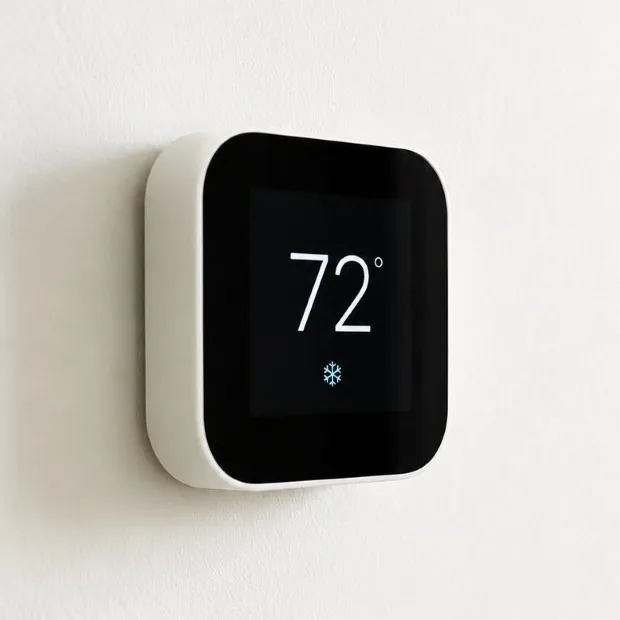
Thermostat Resets or Won’t Hold the Setting
Commercial thermostats are held to rules residential ones are not: a schedule with automatic setback, a manual override that expires after a couple of hours, and a required gap between the heating and cooling setpoints. A stat that snaps back mid-afternoon is usually doing exactly what somebody configured years ago, when the space was used for something else. That is a phone call, not a service call.
Server Room Running Hot
A stat by the door tells you nothing about what the back of the rack is breathing. ASHRAE puts the recommended range for IT equipment at 64.4 to 80.6 degrees measured at the machine's own air inlet — a guideline rather than a red line, but it is measured in the one place nobody is measuring.
Not sure whether you’re looking at a repair or a replacement? Run it through our honest read →
Your Commercial HVAC Contractor
How a Commercial HVAC Service Call Works
No mystery, no pressure, and no work done before you’ve agreed to it.
Model, serial, tonnage, heating input. That plate tells us what the machine is, how old it is, and whether it is inside our license.
When you are open, and what has to keep running while we work. On a two-circuit unit we can often keep half the cooling on.
Temperature split, static pressure, amp draw. Then the failed part, what it costs, and who needs to approve it.
The honest part
Commercial HVAC Advice: What You’ll Be Told, and What We’d Say
Commercial equipment is easy to sell against, because most owners have no reference point for it. Here is where the standard pitch and the actual answer part company.
What you might hear
“You'll need a mechanical contractor for that.”Sometimes true, usually said before anybody read a nameplate. The limit that matters is per system, and most light commercial equipment sits well under it.
“It's fifteen years old. Replace it.”Fifteen is a median, not an expiry date. ASHRAE’s own service‑life database lists 220 packaged rooftop units, and 215 of them were still in service.
“Go up a size and the humidity will sort itself out.”A common recommendation on a clammy building, and it makes the problem worse. Cost is the smaller issue here.
What we’ll tell you
“That's three systems, not thirty tons.”The single most useful sentence on a commercial roof, and the reason a lot of buildings people assume need a mechanical contractor do not.
“This is a contactor, not a machine at the end of its life.”What failed matters more than how old it is. A fifteen-year-old unit that needs a contactor is a fifteen-year-old unit that needs a contactor.
“A bigger unit would make that worse.”Oversized equipment reaches the setpoint faster, runs less, and takes less water out of the air. In this climate, run time is how a building gets dry.
Commercial HVAC Repair, Replacement & Installation
Commercial AC Repair, Replacement or New Installation
Three things happen to commercial equipment, and we do all three — on packaged rooftop units, commercial splits and the controls that run them.
The default, and the one we would rather do. Most of what stops a building is a part rather than a machine — a contactor, a capacitor, a control board, a seized damper linkage. We find what failed, show you the reading that proves it, and give you the number before anything is touched.
The right call when the equipment is otherwise still doing its job.
Sometimes the honest answer, and it has to earn itself. A compressor gone on a unit already struggling, or a cabinet the salt air has eaten through. We will not size the new one off the outgoing unit’s rating — that plate records somebody’s decision, not a measurement of your building. We quote the whole job, not the box.
The right call when the failed part no longer exists, or the metal holding the machine together has gone.
A new suite, a fit‑out, a stockroom that is now full of people. Permitted work that starts with the load rather than a catalogue — what the space is used for, how many people, how much outside air the code asks for. Guess the size here and the building is humid for a decade.
The right call for a fit‑out, a change of use, or a space that never had cooling.
Local Jacksonville HVAC Conditions
Why Commercial HVAC Fails in Northeast Florida
A long cooling season, salt in the air and equipment that runs to a schedule. Four things Northeast Florida does to commercial gear — and where each one lives on your building.
At the beaches and along the Intracoastal, a commercial condenser takes the salt full on — no shade, no side-yard fence, just open air across the cabinet all day. Capacity slips well before anything quits.
Code sets outdoor air by what the room is used for: a thousand square feet of office needs about 85 cfm, the same floor area of restaurant dining about 705. All of it arrives at a Jacksonville dew point, and a building can hit its setpoint and still feel wet.
Rooftop equipment here is designed against a 130 mph wind speed, and what holds it down is the curb and the fasteners into it — not the weight of the unit. Storm damage is rarely dramatic: a lifted panel, a bent damper hood.
Jacksonville logs cooling load in all twelve months. Commercial equipment runs to a schedule rather than to somebody reaching for a thermostat, so it accumulates hours whether the building is occupied or not.
Rooftop units, split systems and wall-mounts
Rooftop Packaged Units, Split Systems and Wall-Mount Units
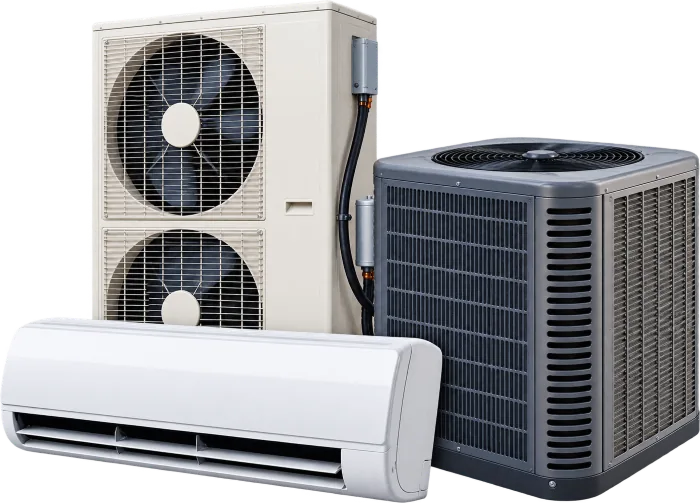
Packaged rooftop and ground-mounted units, commercial split systems, heat pumps and the controls that run them — on strip-center suites, small offices, clinics and dental practices, salons, churches, daycares, shops and small warehouses. Up to 25 tons in any one system, however many of those systems the building has.
Licensed & Insured, FL CAC036942
Licensed, Insured Commercial HVAC Technicians
A working air conditioner is comfort. A system looked after properly is something closer to peace of mind — especially in a Jacksonville August, and especially with small people in the house.
-
Vetted people in your home
Florida state certified — licence CAC036942 — fully insured, and BBB accredited at an A+ rating. The same small crew every time, not a rotating list of subcontractors.
-
The air they breathe all day
Florida humidity does not just make a house uncomfortable — it feeds what grows in it. Filtration, purification and humidity control keep the air in your rooms clean as well as cold.
-
Fixed right the first time
We show you the failed part, quote the whole number before we start, then test the system and clean up behind us. Our work is guaranteed — that is the whole point of the name on the truck.
The full price before we start.
Tell us what your system is doing and we’ll tell you what it actually needs.
S
Sam C.
Paul came out and replaced our blower motor and saved the day. He fielded my call on Sunday evening, then did the service Monday afternoon. Friendly, efficient, and professional.
Read on Google →B
Brian B.
After years of feeling vulnerable to dishonest HVAC companies, a neighbor put me in touch. He quickly earned my trust — quick to return calls, reasonable rates, and he’s never tried to sell me things I don’t need.
Read on Google →L
Lin-Z B.
Beyond reproach. Prompt, professional, and had the problem diagnosed and repaired the same day. Integrity, honesty and great customer service.
Read on Google →C
Carolyn U.
We’ve used him for everything from small tweaks to replacing our entire unit. Quick, reliable, honest, and clean — and he beat the prices of every competitor. Yes, we priced out seven.
Read on Google →T
T. L.
Fast and efficient, unbelievably affordable pricing. He quickly figures out the problem and explains it in a way anyone can understand. You automatically feel like you can trust him.
Read on Google →D
Darin S.
Our A/C went down and the team showed up Monday morning first thing. We had cool air flowing in no time. The crew was fast, clean, and finished under time.
Read on Google →V
Vincent H.
They replaced our entire AC unit and did some duct work. Professional staff and excellent communication. Top quality service and work!
Read on Google →V
Vickie W.
Mike and the team were very professional, friendly, and knowledgeable. The price was not unreasonable. So happy we found this company — we know we will be taken care of in the years to come.
Read on Google →M
Michael C.
Just had Great Dane install a new A/C in my home. Mike came to my home, saw what I had, and I told him what I wanted installed. There was absolutely no sales pressure.
Read on Google →K
Kim S.
Mike came out and gave an estimate with no fluff, which is what I like. He was honest and professional. The team that installed the unit worked well together and the work performed was stellar!
Read on Google →N
Nancy G.
My experience was beyond my expectations. They did an amazing job replacing my antique air conditioner! Mike gave me a great quote and DJ and his son completed this challenging job amazingly well.
Read on Google →A
Andrew M.
Mike with Great Dane did the HVAC for an addition I am the GC on in Atlantic Beach. Extremely professional and great prices.
Read on Google →T
Thomas K.
Our outdated A/C system went down for good and I had called multiple other companies with little to no response. I called Great Dane and Mike was at my house in less than 15 minutes.
Read on Google →P
Paula B.
So glad I went with Great Dane to service my a/c. I highly recommend Quentin, who serviced the unit. He is extremely knowledgeable, highly competent, and up front about potential issues.
Read on Google →G
Ginjabred1
I’d been without A/C for quite some time. It was amazing — the care and concern that Mike (and MJ & Brandon) had about my situation. I know I chose the right company.
Read on Google →AC out? We can come today.
- 4.9 stars
- The full price before we start
- $99 tune-up. Nothing to sign.
Serving the Jacksonville, FL area
Commercial HVAC Near You
Fast, honest HVAC service across Jacksonville, Duval County and the surrounding Northeast Florida communities.
MandarinRiversideAvondaleSan MarcoSouthsideBaymeadowsArlingtonSpringfieldNorthsideWestsideJulington CreekNocateePonte VedraJacksonville BeachAtlantic BeachNeptune BeachOrange ParkFleming IslandMurray HillIntracoastal WestSt. Augustine
Book online
Commercial HVAC FAQ
Commercial HVAC Questions From Business Owners
Straight answers, no jargon — including the ones that cost us money to answer honestly.
Are you licensed for commercial work?
Yes, and the license comes with a number you can check and a limit worth knowing before you call. Great Dane holds Florida license CAC036942, a Certified Air Conditioning Contractor license with a Class B qualification. Florida law limits Class B to 25 tons of cooling and 500,000 BTU per hour of heating in any one system; Class A is the same trade with no cap. You can pull that record up yourself on the state's site — and it is worth doing with any contractor you are about to let onto your roof.
Our building needs more than 25 tons. Does that rule you out?
Usually not, because the limit is written per system, not per building. A building running three 10-ton rooftop units is thirty tons in total and every one of those systems is inside the limit. What puts a job outside it is a single machine over the cap — one large packaged unit, a chiller, an air handler fed by a central plant. If you are not sure which of those you have, the data plate settles it, and we would rather work that out on the phone than after we have driven out.
How do I find out how big our unit is?
The nameplate. It is on the cabinet, usually near the electrical access panel, and it carries the model and serial number. You may have read that the capacity is hidden in the model number, and often it is — 12,000 BTU per hour is one ton, so a 048 is four tons on a lot of equipment. But the manufacturers do not agree with each other. Some number their commercial units in tons instead, so the same three digits can mean twelve times what you assumed. Send us a photo of the whole plate rather than the arithmetic. And if the unit is on a roof you cannot safely reach, do not go up there on our account.
What is outside your license, and who should we call instead?
One system over 25 tons of cooling or 500,000 BTU per hour of heating. Past that the work belongs to a Class A air conditioning contractor or a mechanical contractor, and we cannot legally take it — that is not a preference. Boilers and unfired pressure vessels sit outside Class B at any capacity, size has nothing to do with it. So do pressure piping, process piping and pneumatic control loops. Fire suppression over a commercial kitchen hood is a different regulator altogether — the State Fire Marshal, not the construction board — and nobody holding only an air conditioning license should be touching it. Tell us what is on your roof and we will tell you which side of the line it falls on, whether or not the job ends up being ours.
Our unit is on the roof. Is that a problem?
On a roof, the first question is the nameplate rather than the ladder. Packaged rooftop units are sold in a light commercial range that tops out around 25 tons, which is exactly where our license stops — per system, so three 10-ton units on one roof are three separate systems and all three are inside it. Send a photo of the data plate and you have the answer before anybody climbs anything. Two other things a roof genuinely changes: getting up there needs sorting before the visit rather than during it, and replacing a unit is a different job from repairing one. On most change-outs the old unit comes off the curb by crane and the curb has to be flashed and sealed again afterwards, which in Florida is a roofing contractor's licensed scope, not ours.
Our server room runs hot. Is that an air conditioning problem?
More often it is a wrong-equipment problem than a broken-equipment one. A server closet throws off the same heat in January as in July, while the building's comfort system is designed around people and is frequently locked out overnight, at weekends, or when it is mild outside — which is exactly when the room cooks. Two things to check before you assume the unit is failing. First, whether that split is rated to cool at a low outdoor temperature at all; the operating range is in that model's installation manual, not on the nameplate. Second, where the temperature is being measured. A stat by the door tells you nothing about what the back of the rack is breathing.
We only have one unit for the whole space. Does that change anything?
It changes what failure looks like. With one packaged unit there is no partial failure and nothing to limp along on — the building either has cooling or it does not. On a two-circuit rooftop unit you can lose half the capacity and stay open; on a single machine you cannot. That is not an argument for buying a second unit. It is an argument for knowing the condition of the one you have before August rather than during it, and for treating a small fault on it as a scheduling decision rather than something to sit on.
Who pays for the rooftop unit, us or the landlord?
Your lease decides that, and it is worth reading the clause before you approve anything. Commercial leases split HVAC in more ways than a homeowner ever has to think about. A lease can put routine maintenance on one party and replacement on the other. It can cap what the tenant contributes in a year. It can have the landlord carry a replacement and recover a share of it from you across the equipment's remaining useful life. Triple-net leases quite often put the whole thing on the tenant. Those are separate questions with separate answers, and the answers are in your document, not ours. What we will do is tell you what we measured and what actually failed, before any work happens, so whoever ends up paying is looking at the same numbers you are.
I lease my space. Can I call you directly?
Yes. The thing worth settling before we come out is not the diagnosis, it is the paperwork. Your lease decides who is responsible, and it genuinely varies — retail, office and warehouse space are not the same on this point, and some leases require the landlord's own contractor. Read it, or tell us you have not, and say on the phone who authorises the spend. Tell us the tonnage too if you know it, because a single unit over 25 tons is a job we would rather turn down on the phone than on site.
Do we need a permit to replace a commercial unit?
Yes. The code is explicit: anyone intending to install, alter, repair, remove or replace a mechanical system has to apply to the building official and get the permit before the work starts. The exemptions are narrow — portable equipment and minor parts that do not change the equipment's approval. Swapping a rooftop unit or a split system is not on that list. Florida does let an owner act as their own contractor on a commercial building up to a limit, but only for a building they occupy themselves and do not lease out, so on leased space that route is closed in both directions and the permit comes from the licensed contractor. Check which department, too: Jacksonville takes applications through its own portal, but Jacksonville Beach, Atlantic Beach, Neptune Beach and Baldwin never consolidated with the city and run their own building departments. A contractor who offers to skip the permit is not saving you a step — he is moving the exposure off his license and onto your building.
What is the $5,000 rule, and does it apply to us?
It is a residential rule of thumb — the age of the unit multiplied by the repair cost, and if the answer clears $5,000 you replace — and it does not travel well to commercial equipment. It was built around a house with one system, where the only thing riding on the decision is comfort. On a commercial building the arithmetic is different: whether this unit is one of four or the only one, what it is actually cooling, and what the roof work adds on top of the equipment. We will still give you the number both ways. We are just not going to pretend a formula from a blog post knows your building.
How long should a rooftop unit last?
Sixteen years is the median in ASHRAE’s service‑life database for a packaged rooftop unit, and a median is not an expiry date — it is the age at which half of them are still going. The more useful number in the same table is the count: of the 220 rooftop units in it, 215 were still in service. Age on its own is not a diagnosis. What failed, what it costs to put right, and what the rest of the machine looks like are the things that decide it, and a unit that needs a contactor is a unit that needs a contactor whatever year it was made.
Our unit runs R-410A. Do we have to replace it?
No. R-410A equipment can still be serviced, and nothing obliges you to pull out a working unit. What changed is manufacture: since 1 January 2025, new residential and light commercial air conditioning and heat pump systems have to use a lower-GWP refrigerant, which is why new equipment ships with R-454B. EPA has since proposed dropping the installation deadline, which is why pre-2025 stock is still moving. The practical effect on you is that topping off an older R-410A system gets a little pricier each year — a reason to plan a replacement, not a reason to make one today.
Is a maintenance agreement worth it?
You do not need one to book a visit, and nobody should be signed on to something recurring on a first visit. What scheduled maintenance genuinely buys on commercial equipment is that somebody is looking — the filters, the belts where there are still belts, the economizer, the condensate drain that blocks up through our long cooling season. Economizers are the clearest case: they fail quietly, usually a stuck damper or a drifted sensor, and the building gives you no hint either way. Some of what a visit catches is a failure avoided outright. The rest is a repair you schedule instead of one that picks its own afternoon. What we will not tell you is that any arrangement makes a unit unbreakable.
One call covers the rest of the house.This page is one job. These are the others.