
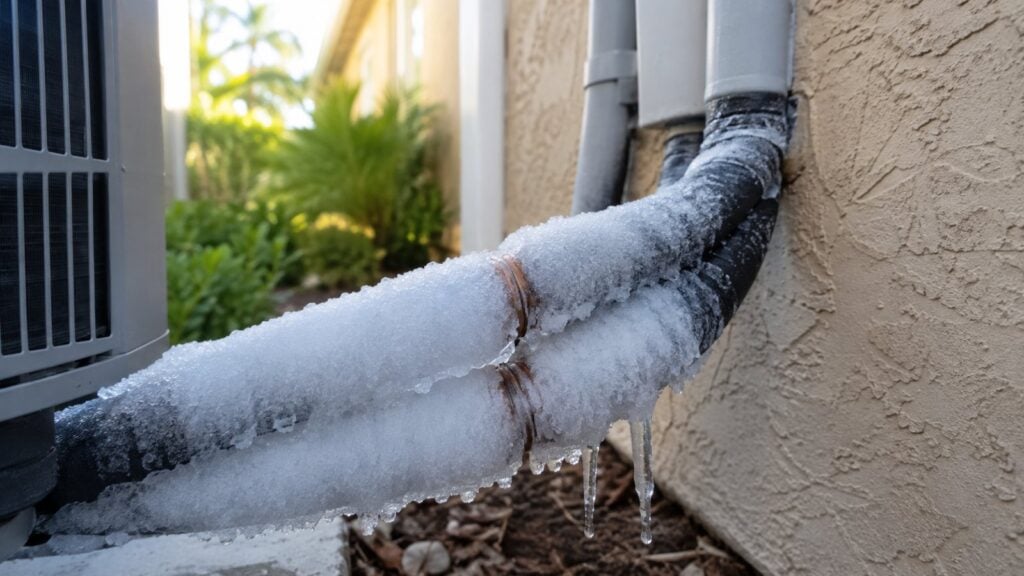
Ice on an air conditioner in ninety-degree weather looks like a contradiction, but it is ordinary physics. Your evaporator coil is supposed to run cold — just not below freezing. When it drops under 32 degrees, the moisture condensing on it stops draining and starts building, and once a little ice forms it insulates the coil and the problem accelerates.
Almost every frozen system comes down to one of two things: not enough air moving across the coil, or not enough refrigerant in it. Everything below is a version of one of those.
What to do right now
Turn the cooling off at the thermostat and set the fan to ON. That pushes room-temperature air across the coil and melts the ice far faster than leaving the whole system off. It is the one situation where fan ON is exactly right.
Then leave it alone. A full thaw usually takes a few hours, sometimes longer if the ice has built into a solid block, and there is no way to rush it safely.
Do not chip at it. The fins and the tubing they are attached to are soft aluminum and copper, and a screwdriver goes through them easily — turning a frozen coil into a leaking one. Do not aim a heat gun at it either.
Put towels down. All that ice becomes water, and the drain pan under a coil is sized for normal condensate, not for a thawing block of it. In a Jacksonville house the air handler is usually in the attic, directly above a ceiling.
And do not switch cooling back on until it has fully thawed. Running a frozen system can send liquid refrigerant back to the compressor, which is the most expensive part in the whole machine and the one least able to cope with it.
The airflow side, which is most of them
The coil needs a steady volume of warm air across it to stay above freezing. Choke that supply and the temperature falls.
The filter is the usual culprit and the easiest to rule out, and it is the first thing a seasonal tune-up deals with. Hold it up to a light — if you cannot see light through it, it has been restricting airflow for a while.
After that it is worth walking the house and looking at the vents. Closing registers in unused rooms feels like it should save money, and it does the opposite: the system still moves the same volume of air, just through fewer openings, which raises static pressure and lowers flow across the coil. Furniture pushed against a return grille does the same thing.
Beyond that it gets into things you cannot see. The evaporator coil itself can be matted with dust even when the filter looks fine. A flex duct in the attic can be crushed or kinked. A blower wheel can fill with debris, or a motor can be slowing down without failing outright. Those need somebody with a manometer, because the symptom looks identical from inside the house.
The refrigerant side, and why topping it off is not a fix
If refrigerant is low, the pressure in the coil is low, and refrigerant boils at a lower temperature when the pressure drops. That pushes the coil below freezing even with perfect airflow.
Here is the part that matters: refrigerant is not a consumable. It circulates in a sealed loop and is not used up like fuel. If the charge is low, it went somewhere, and that means a leak.
So a company that adds refrigerant and leaves has sold you a few months. The charge will drop again, the coil will freeze again, and you will pay for the same refrigerant twice. The right sequence is to find the leak, decide whether it is worth repairing or whether the age of the system makes replacement the better answer, and only then talk about charge.
A few things that are specific to here
Jacksonville humidity means your coil is pulling gallons of water out of the air on a summer afternoon. There is simply more moisture available to freeze onto a coil that has started running cold, so a marginal system that might limp along in a dry climate ices up here instead.
Attic air handlers make the consequences worse. The equipment is above a ceiling, so a thaw that would be a puddle in a garage becomes a stain on drywall.
And setting the thermostat far below where you actually want it does not cool the house faster. The system runs at one speed either way. What a very low setpoint does is keep it running continuously, which on a system that is already marginal on airflow or charge is exactly the condition that lets ice start.
Overnight running is worth watching too. When the outdoor temperature drops, so does the pressure in the system, and a unit that behaved all day can freeze at four in the morning. If you wake up to no cooling and find ice, that timing is a clue rather than a coincidence.
When it is not ice at all
Not every wet or cold-looking line set is frozen. Some condensation on the large insulated line is normal on a humid day. What is not normal is a white jacket of frost or a solid block, or water where water has never been before.
If the system is not cooling but there is no ice anywhere, this is not your problem — that is a different fault, and worth saying so before anyone starts hunting for a leak.
When to call somebody
If it freezes once, thaw it, change the filter, open the vents and see whether it happens again. That is a reasonable thing to try yourself and it solves a fair number of them.
If it freezes a second time, stop cycling it. Repeated freeze-and-thaw is hard on the compressor, and the second occurrence tells you the cause is something that needs gauges and a static pressure reading rather than a new filter.
Call sooner than that if you find oily residue near the line set or the coil, which usually points to a refrigerant leak, or if water has already reached a ceiling.
When we come out for a frozen system, the first job is working out which side of the fault it is — airflow or charge — because the answers are completely different, and guessing between them is how people end up paying for refrigerant they did not need.