When your AC runs but doesn’t cool the house, the usual causes are a bad capacitor, a dirty filter or coil, low refrigerant from a leak, a frozen indoor coil, leaky ducts in a hot attic, or a system that is too small or too old for the house. You can safely check the thermostat, filter, breakers, and outdoor unit yourself. Anything involving electrical parts, refrigerant, or ice that keeps coming back needs a technician.
What does it mean when your AC runs but doesn’t cool?
Running but not cooling can mean a few different things. Each one points to different causes.
- Warm air from the vents. The indoor fan runs, but the air feels like room temperature. Often the outdoor unit is not running or not moving heat.
- Cool air, but the house won’t drop. The air feels cool, but the thermostat sits at 78 or 80 all afternoon. This is the classic sign of a system that can’t keep up.
- Cooling that fades. It cools in the morning and gets worse through the day. This can point to a freezing coil, low refrigerant, or a system at its limit.
Check the temperature split
If you have a kitchen thermometer, let the system run for about 15 minutes. Hold the thermometer at a supply vent, then at the return grille. A healthy system typically shows a difference of about 15 to 20 degrees. A much smaller difference tells a technician the system is not removing enough heat.
The takeaway: Note which of these three patterns you have, because it narrows down the cause before anyone opens the unit.
What can you safely check before calling for AC repair?
Thermostat
Confirm it is set to Cool, the setpoint is below room temperature, and the fan is on Auto. Replace the batteries if it uses them.
Air filter
Pull it and look. A clogged filter chokes airflow and can freeze the coil. Florida systems run most of the year, so filters typically need changing every one to three months.
Breakers
Check the breakers for the indoor and outdoor units. If one has tripped, reset it once. If it trips again, leave it off and call.
Outdoor unit
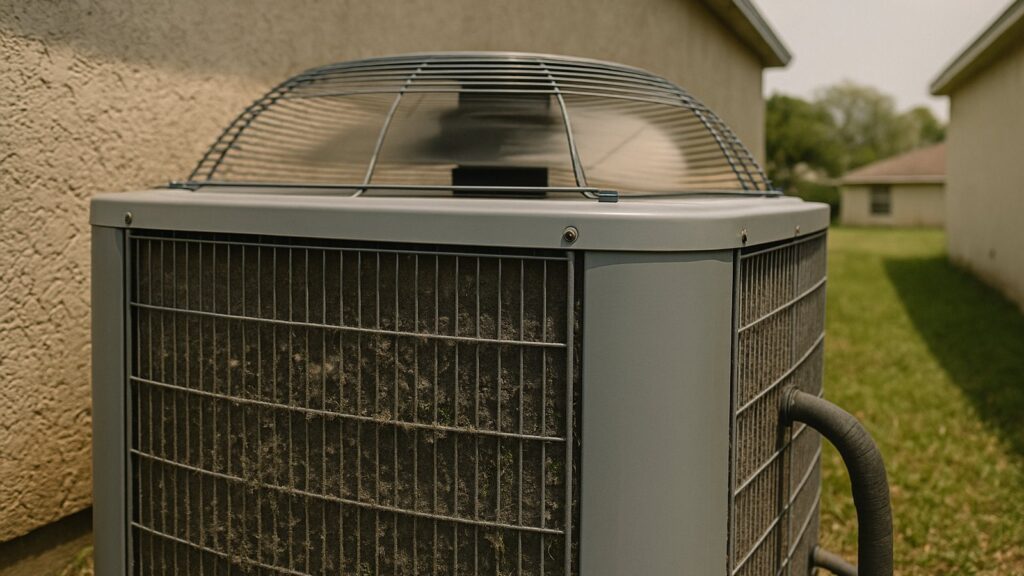
Go outside while the system is calling for cooling. The fan on top should spin and you should hear the compressor. Clear leaves, grass clippings, and plants so there is typically about two feet of open space around it. If the unit hums but the fan does not turn, shut the system off at the thermostat.
Ice
Look at the larger copper line at the outdoor unit. If you see frost or ice, turn cooling off and run the fan only so it thaws. Our post on why your AC freezes up in a Florida summer covers this in more detail.
Vents and returns
Make sure furniture, rugs, and closed doors are not blocking supply vents or the return grille. Keep stored boxes and laundry away from the indoor unit’s return as well.
Stop there. Do not open the electrical panels on the units, do not touch the capacitor, and do not try to add refrigerant.
The takeaway: Thermostat, filter, breakers, outdoor unit, ice, and vents are yours to check; everything inside the panels is not.
What causes an AC to run but not cool in Northeast Florida homes?
A bad capacitor
The capacitor gives the compressor and outdoor fan motor the push they need to start. Constant heat wears them down, and power surges from summer storms can finish them off. A bad capacitor is a common reason the indoor fan runs while the outdoor unit hums or sits still. The repair is usually simple, but capacitors store a charge even with the power off, so it is a technician job.
A dirty filter or coil
The indoor coil collects dust that gets past the filter. The outdoor coil collects pollen, grass, and dirt. Near the coast in Ponte Vedra and St. Augustine, salt air also corrodes outdoor coil fins. A dirty or damaged coil cannot move heat well, so the system runs longer and cools less.
Low refrigerant or a leak
Refrigerant runs in a sealed loop and is not used up. If it is low, there is a leak. Adding refrigerant without finding the leak means the warm house comes back later.
A frozen coil
Low airflow or low refrigerant can drop the coil below freezing. Ice blocks airflow and cooling falls off. Thawing it helps for a while, but the cause is still there.
Duct leaks in a hot attic
Many homes around Jacksonville, Orange Park, and Fleming Island have ductwork in the attic. In summer the attic gets much hotter than the outdoor air. A disconnected run, torn flex duct, or leaky joints can dump cooled air into the attic or pull hot attic air into the return. Rooms at the end of long runs get warm first.
Every leak in an attic duct wastes air the system already cooled. If you suspect your ducts, see our duct services in Jacksonville.
An undersized or aging system
Some systems were sized too small when installed. Others lost capacity with age, or the house changed with an addition or a converted garage. Older systems that use R-22 refrigerant are harder to repair because that refrigerant is no longer produced. If your system uses R-22, ask the technician how that affects your repair options.
The takeaway: Most not-cooling calls trace back to one of these six causes, and more than one can be present at once.
Why does your AC only cool to 80 degrees on hot afternoons?
Residential systems are typically sized to hold about 75 degrees indoors at the local design temperature. For Jacksonville, that design temperature is in the low to mid 90s. On a hotter afternoon with full sun on the west wall, a correctly sized system may run nonstop and lose a degree or two. That is normal.
A house that will not cool below 80 degrees while it is in the low 90s outside is different. That points to one of the causes above, or several at once. A slightly dirty coil, a small duct leak, and a weak capacitor can each look minor alone. Together they add up to an under-performing unit.
Humidity matters too. Low airflow or short cycling can leave the house damp, and damp air feels warmer than dry air at the same temperature. If that sounds familiar, read why your house feels sticky at 74 degrees.
The takeaway: Drifting a degree or two on the hottest days is normal, but sitting at 80 when it is in the low 90s outside is not.
Which AC problems can you check yourself, and which need a technician?
| Symptom | Safe for you to check | Needs a technician |
|---|---|---|
| Warm air, outdoor unit silent | Thermostat settings, breakers | Breaker trips again, contactor or capacitor testing |
| Outdoor unit hums, fan not spinning | Turn the system off | Capacitor, fan motor, or compressor testing |
| Ice on the lines or coil | Turn cooling off, run the fan, change the filter | Ice comes back, refrigerant check, leak search |
| House stuck at 78 to 80 | Filter, blocked vents, clear the outdoor unit | Coil cleaning, refrigerant charge, duct inspection, sizing check |
| Some rooms warm, others fine | Open vents, look for crushed duct visible from the attic hatch | Duct leak testing and repair |
| Water near the indoor unit, cooling stops | Look for a clogged drain line | Float switch, drain, or pan repair |
Some systems have a float switch that shuts off cooling when the drain backs up. See why your AC drain line clogs in a Florida summer for that problem.
The takeaway: If your check doesn’t fix it the first time, or the symptom comes back, it belongs in the right-hand column.
What should a real AC diagnosis include?
A real diagnosis is measurements, not a guess. On a not-cooling call, a technician should:
- Check voltage and amp draw on the compressor and fan motors.
- Test the capacitor and compare the reading with the rating printed on it.
- Measure refrigerant pressures and line temperatures to see whether the charge is right.
- Measure the temperature difference between return and supply air.
- Inspect the filter, indoor coil, and outdoor coil.
- Check airflow and the ductwork if the symptoms point there.
What you should hear afterward
You should get a clear explanation of what was found, which reading was off, and what the repair is. If replacement comes up, you should hear why. That means the system’s age, the refrigerant it uses, the condition of the compressor or coil, and what a repair would and would not fix.
What a sales pitch looks like
Replacement is the first recommendation before any testing. Duct replacement is recommended without anyone going into the attic. You are told the decision has to be made today. A snap decision on a full replacement is rarely needed when the problem is one part. Asking to see the readings, or getting a second opinion, is reasonable.
The takeaway: Ask for the readings behind any recommendation, and expect a plain explanation of what failed.
When should you call a pro, and what should you tell them?
Call for AC repair in Jacksonville if the safe checks did not fix it. The same goes if a breaker trips twice, ice returns after thawing, or the outdoor unit hums without running. Keep the system off in the meantime if it is humming, buzzing, or freezing, so a small problem does not damage the compressor.
If the house is getting hot and someone at home is elderly, very young, or has a health condition, treat it as urgent. Use our emergency AC repair service.
What to tell us when you call
- What you already checked.
- What the outdoor unit is doing: running, humming, or silent.
- How warm the house gets.
- Roughly how old the system is.
That helps the technician come prepared.
Great Dane Heating & Air is family-owned, Florida license CAC036942, and serves Jacksonville, Orange Park, Fleming Island, Ponte Vedra, and St. Augustine. Estimates are free. You can contact Great Dane Heating & Air to schedule a visit.
The takeaway: Call after one failed round of safe checks, and shut the system off if it is humming, buzzing, or icing.
What should you do next?
Start by naming the pattern: warm air, a house stuck at 78 or 80, or cooling that fades. Run the safe checks once. If the problem stays or comes back, turn the system off and have it tested with real measurements before anyone talks about replacement.
If your AC is running but not cooling, contact Great Dane Heating & Air to schedule a diagnosis. Estimates are free.
Frequently asked questions
Why did my AC stop cooling after a storm or power outage?
A power outage can leave the thermostat or the outdoor unit out of step, and some systems need a reset before they cool again. Check that the breakers are on and give the system time before restarting it. Our guide on how to reset your AC after a power outage (https://greatdaneair.com/how-to-reset-your-ac-after-a-power-outage/) walks through the steps.
Should my AC fan be set to On or Auto in Florida?
Auto is usually the better choice in a humid climate. With the fan on Auto, water on the indoor coil has time to drain away between cycles. With the fan on On, air keeps blowing over the wet coil and can put some of that moisture back into the house.
Does closing vents in unused rooms help the AC cool better?
Usually not. Closing supply vents cuts the total airflow across the indoor coil, which can make the system work harder and can contribute to a frozen coil. Keep vents open and have uneven rooms checked for duct problems instead.
Will a new thermostat fix an AC that won’t cool?
Only if the thermostat itself is the problem, such as a failed unit, loose wiring, or a bad location. A thermostat on a sunny wall or near a lamp can read the room wrong and shut the system off early. If the thermostat is calling for cooling and the house still stays warm, the cause is in the equipment or ducts.
Can I hose off my outdoor AC unit myself?
Yes, with the power off at the thermostat and the outdoor disconnect or breaker. Use a gentle stream from a garden hose, never a pressure washer, and do not bend the thin metal fins. Rinsing is especially helpful near the coast where salt and sand build up on the coil.
How do I find out what refrigerant my AC uses?
Look for the data label on the side or back of the outdoor unit. It lists the model, serial number, and refrigerant type, such as R-22 or R-410A. Have that label handy when you call so the technician knows what the system needs.
How often should an AC be serviced in Jacksonville?
Because systems here run most of the year, at least one tune-up a year is a common recommendation, ideally before the hottest months. A tune-up is the time to clean coils, check the charge, and test parts like the capacitor before they fail. See our HVAC maintenance and AC tune-ups page (https://greatdaneair.com/hvac-maintenance-jacksonville/) for maintenance plans.