Ductless Mini-Split Installation & Service in Jacksonville, FL
Mini Split Installation and Repair Across Jacksonville
A garage, a bonus room over it, a Florida room, an addition the old ductwork was never going to reach — the rooms a mini-split is genuinely right for, and the ones it is not. We size it from a load calculation, tell you which side of that line your room is on, and give you the number before anything is ordered.
Get a free estimateTell us what it’s doing — we’ll come back fast.
Ductless AC in Jacksonville, FL
The Right Tool for Some Rooms, the Wrong One for Others
A ductless mini-split is a small outdoor unit and one or more indoor heads joined by a refrigerant line set, with no ductwork between them. That makes it the answer to a specific set of problems: the garage, the room built over it, the Florida room, the addition, the detached office — places the existing system was never designed to reach, or that Florida code will not let it reach. It also makes it the wrong answer to a different set of problems it gets sold for anyway, and a sticky, clammy room is the big one. We install and service them. We also tell people fairly often that what they actually need is a load calculation on the system they already have, or a dehumidifier, and not another outdoor unit on the side of the house.
Great Dane Heating & Air has kept Jacksonville and Duval County comfortable for more than twenty years. We are a family company — the people who answer the phone are the people who show up — with upfront pricing, comfort techs who treat your home like their own, and a soft spot for shelter dogs. Every job we finish gives back to the Jacksonville Humane Society.
Most mini-split calls come down to a handful of rooms the central system cannot serve properly, and a couple it should never have been asked to. Tap whichever one sounds like your house.
Florida code does not allow the home's duct system to have any opening into an attached garage, so “we'll just run a vent out there” is not an option anybody licensed should be offering. A ductless head is the code-clean way to cool a garage, a garage gym, or a conversion — which is why it is the most common room we put one in.
It sits at the end of the longest duct run in the house, under the roof, over an unconditioned space, and it is the last room the system gets to on a July afternoon. Extending the ductwork puts more duct in a vented attic, where the Department of Energy attributes a large share of heating and cooling energy to duct losses. A head of its own is usually the honest fix.
Adding a room to a system sized for the house before the room is a load-calculation question, not a guess. Florida code requires equipment to be sized from a Manual J load calculation, and that same calculation is the objective test of whether the existing system can absorb the new room or whether the room needs its own.
Glass on three sides, a long way from the air handler, sometimes across a breezeway. These are single-room loads with their own schedule, and a single-zone mini-split can turn down to a fraction of its capacity to sit with a small room all evening. That turndown is the whole point of the technology — and it is much smaller on a multi-zone system, which is worth knowing before you are quoted one.
This is the one a mini-split gets sold for and should not be. A U.S. Department of Energy field study in Florida's own climate zone found homes cooled by right-sized mini-splits, with ventilation and no dehumidifier, running above 60% indoor humidity for a large share of the hours measured — most of it in the mild months when the system barely ran. Humidity is a design problem. A bigger or second head makes it worse, not better.
Water down the wall is almost always the drain, not the unit: a wall head has no pump and drains by gravity through a small hose, so a belly in that hose or an outdoor end buried in mulch backs it up. A musty puff when it starts is the blower behind the coil, which the filter you rinse never touches. And a head that shuts itself off with an error light has very likely had its float switch do exactly its job.
Cannot be combined with any other offer. One per household.
Our Mini Split Repair Process
How a Mini-Split Job Actually Goes
No mystery, no pressure, and no work done before you’ve agreed to it.
01We calculate the load before we pick a size
Florida code requires it, and it is the only way to know whether the room needs a mini-split at all. Manual J on the room, Manual S on the equipment — and the latent side, the moisture, sized on its own.
02We spell out the electrical and the permit
A new dedicated circuit is electrical-contractor work, not air-conditioning work, and the install needs a mechanical permit and inspection. Both are written into the proposal, not discovered on the day.
03We place the outdoor unit for the weather it will get
Off the ground, on a support built to hold in wind, out of direct salt spray at the beaches, and somewhere rain can still rinse the coil. Where the unit sits decides how long it lasts.
04We run the drain the way the code and the manual say
A continuous fall from the head to the outside, a check valve or trap in the line, an overflow shutoff where the head is over finished space, and UV-rated jacket on the line set — not tape.
The honest part
Three Things You'll Be Told, and What We'd Say Instead
Mini-splits are easy to oversell, because the technology is genuinely good and most homeowners have never owned one. Here is where the standard pitch and the honest answer part company.
What you might hear
“It runs all the time on low, so it pulls the humidity right out.”Running long does not automatically mean running dry. At low speed many heads run a warmer coil and more air per ton, and the moisture they remove can be less than what the ventilation is bringing in.
“No permit needed — it's just a mini-split.”Wrong. The permit exemption for small refrigeration appliances does not cover a split system. A mini-split install in Duval County needs a mechanical permit and an inspection, and skipping it surfaces at resale.
“Your R-410A unit is illegal now. Time to replace it.”Repairing and recharging an existing R-410A mini-split is not banned and will not be. The 2025 rule applies to new systems. What is true is that R-410A supply is being squeezed by a separate phase-down.
What we’ll tell you
“Humidity gets designed for, or it does not happen.”The DOE's Florida field study put it plainly: where tighter humidity control is required, a supplemental dehumidifier is needed. A head is not a dehumidifier.
“The drain is where these fail, so it gets done right.”A wall head drains by gravity through a hose the width of a pencil. In a Jacksonville summer that hose is working for months. The fall, the trap, and the float switch are not optional.
“That room does not need a mini-split. It needs a load calc.”Some rooms are a duct-balancing problem on the system you own. We would rather tell you that than sell you an outdoor unit you did not need.
There is no ductwork in a ductless system. Everything that moves between outside and inside goes through one opening about three inches across. Here is what each piece does, and where this climate leans on it.
OutsideInside
Outside
1
The outdoor unit
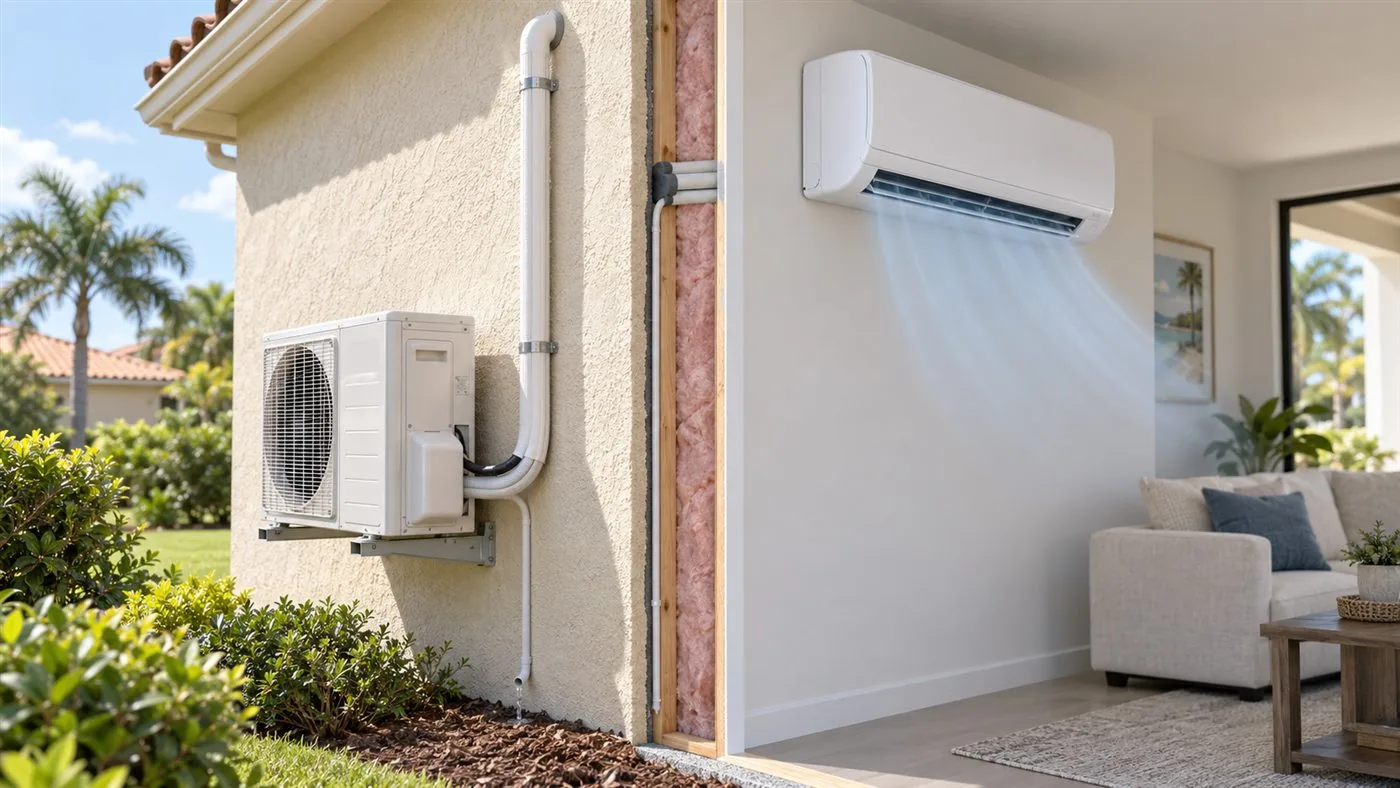
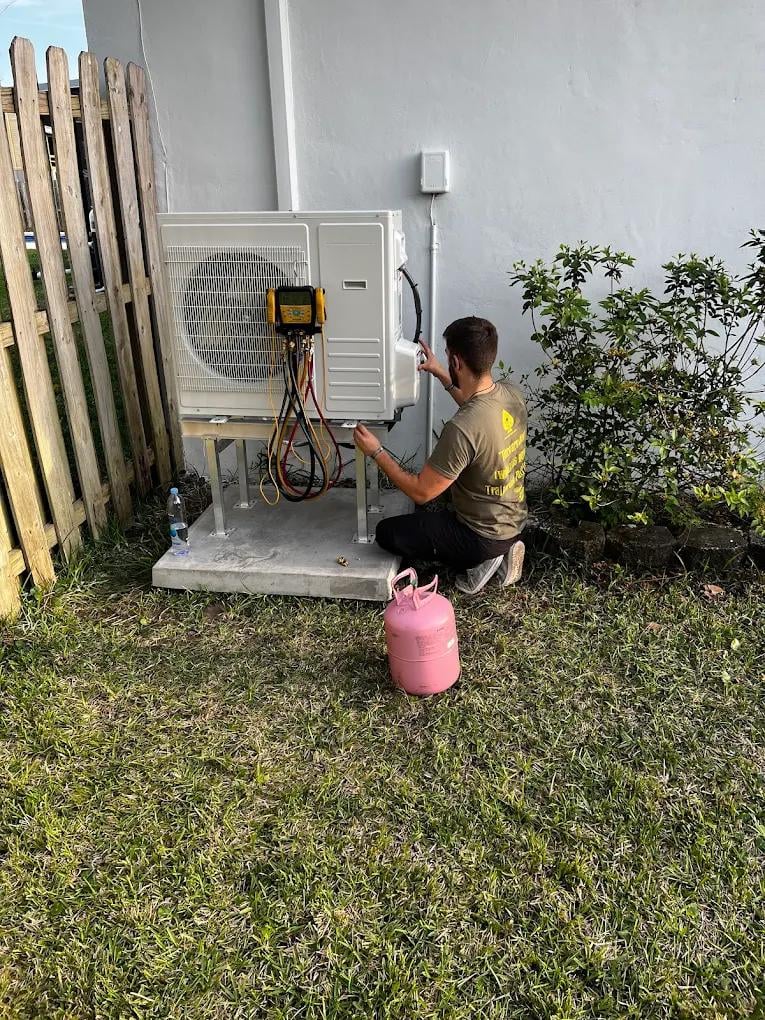
The compressor and the outdoor coil, on a pad or a wall bracket like this one. Florida code treats the supports as part of the installation: the unit and whatever holds it both have to be built to resist wind, and in a flood hazard area the unit sits elevated. Near the coast it also wants to be out of direct salt spray, somewhere rain can still rinse the coil.
4
The drain
There is no pump. Condensate falls by gravity through a hose the width of a pencil, so the whole run has to slope continuously to the outside, with a check valve or trap in the line. Over finished floors the code requires overflow protection — a float switch in the head's own pan that shuts the unit off before water reaches the wall.
Through the wall & inside
2
The line set
Two insulated copper refrigerant lines, the control wire and the drain hose, bundled through a single small hole. The insulation on the outside wall has to be shielded from sun and weather by code, and the code specifically rules out tape as that shield — a cover like the one in the picture is what it means.
3
The indoor head
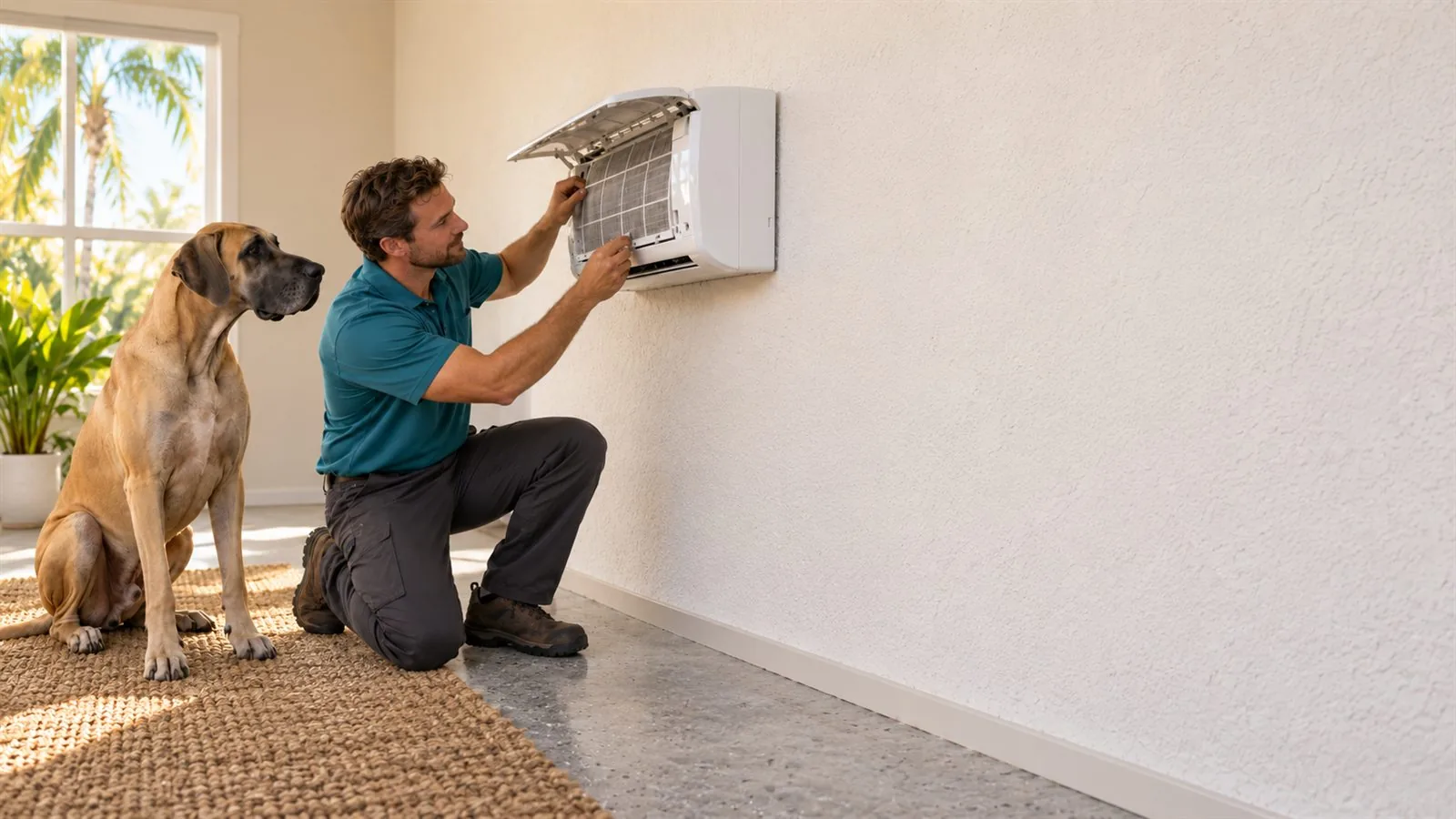
A coil with a long, quiet blower fan behind a washable filter. It cools the room and pulls moisture out of the air, and that water has to go somewhere. The filter is yours to rinse; the fan and coil behind it are a service visit, because reaching them means opening the unit.
Local Jacksonville HVAC Conditions
Why Mini-Splits Fail in Jacksonville — and What We Fix
We repair mini-splits all summer long, and most of the calls are the same four problems — every one of them this climate’s doing. Here is what each one feels like from inside the room, and what actually fixes it.
78°Set to 78° — nine months a year
Warm airIt runs, but it blows warm
A head that runs and will not cool is usually a coil that cannot move heat: a filter or coil furred with a season of Jacksonville air, or a refrigerant leak somewhere on the line set. We clean the coil, test the charge and find the leak. Opening the refrigerant circuit is EPA-certified work, so this is a repair — not a top-off every summer.
The smellA musty puff when it starts
The washable filter is a coarse screen. Behind it the coil stays wet for most of the year, and the blower sits right downstream of it. A 2023 study in Indoor Air found fungal growth on every interior part of the wall heads it opened, the fan most of all. Rinsing the filter never reaches it. We open the head and clean the fan and coil properly.
WaterDripping, or it shut itself off
A wall head has no pump. It drains by gravity through a hose the width of a pencil that works for months in a summer here, and slime in that hose backs water down the wall — or trips the float switch the code requires over finished floors, so the head stops with an error light. We clear and re-slope the drain and check the trap.
Salt & sunWeathering on the outside wall
Mitsubishi Electric and Daikin both name salty coastal air in their manuals as a place trouble is liable to occur, and Florida code requires the line-set insulation to be shielded from sun — tape does not count. We rinse and clear the outdoor coil, and re-jacket bare foam before the sun finishes it off.
Mini Split Service Across Jacksonville
Single Zones, Multi-Zones, and the Room Nobody Planned For
Single-zone and multi-zone ductless systems for garages and garage conversions, bonus rooms, Florida rooms, additions, detached offices and studios — installed under a permit, sized from a load calculation, and serviced afterward by the same crew. We also service and clean the heads other people installed.
A working air conditioner is comfort. A system looked after properly is something closer to peace of mind — especially in a Jacksonville August, and especially with small people in the house.
Vetted people in your home
Florida state certified — licence CAC036942 — fully insured, and BBB accredited at an A+ rating. The same small crew every time, not a rotating list of subcontractors.
The air they breathe all day
Florida humidity does not just make a house uncomfortable — it feeds what grows in it. Filtration, purification and humidity control keep the air in your rooms clean as well as cold.
Fixed right the first time
We show you the failed part, quote the whole number before we start, then test the system and clean up behind us. Our work is guaranteed — that is the whole point of the name on the truck.
Free estimate, honest answer.Tell us what your system is doing and we’ll tell you what it actually needs.
Paul came out and replaced our blower motor and saved the day. He fielded my call on Sunday evening, then did the service Monday afternoon. Friendly, efficient, and professional.
After years of feeling vulnerable to dishonest HVAC companies, a neighbor put me in touch. He quickly earned my trust — quick to return calls, reasonable rates, and he’s never tried to sell me things I don’t need.
We’ve used him for everything from small tweaks to replacing our entire unit. Quick, reliable, honest, and clean — and he beat the prices of every competitor. Yes, we priced out seven.
Fast and efficient, unbelievably affordable pricing. He quickly figures out the problem and explains it in a way anyone can understand. You automatically feel like you can trust him.
Our A/C went down and the team showed up Monday morning first thing. We had cool air flowing in no time. The crew was fast, clean, and finished under time.
Mike and the team were very professional, friendly, and knowledgeable. The price was not unreasonable. So happy we found this company — we know we will be taken care of in the years to come.
Just had Great Dane install a new A/C in my home. Mike came to my home, saw what I had, and I told him what I wanted installed. There was absolutely no sales pressure.
Mike came out and gave an estimate with no fluff, which is what I like. He was honest and professional. The team that installed the unit worked well together and the work performed was stellar!
My experience was beyond my expectations. They did an amazing job replacing my antique air conditioner! Mike gave me a great quote and DJ and his son completed this challenging job amazingly well.
Our outdated A/C system went down for good and I had called multiple other companies with little to no response. I called Great Dane and Mike was at my house in less than 15 minutes.
So glad I went with Great Dane to service my a/c. I highly recommend Quentin, who serviced the unit. He is extremely knowledgeable, highly competent, and up front about potential issues.
I’d been without A/C for quite some time. It was amazing — the care and concern that Mike (and MJ & Brandon) had about my situation. I know I chose the right company.
Straight answers, no jargon — including the ones that cost us money to answer honestly.
How do I know a mini-split is right for my room and not the wrong fix?+
Ask for the load calculation. Florida code requires heating and cooling equipment to be sized from a Manual J calculation, and that same calculation tells you whether the existing system can absorb the room or whether the room needs its own. If a contractor sizes by the square footage or by what the last house had, you are being guessed at. The second question is what the actual complaint is. A room that will not get cold is a capacity problem and a mini-split may well be the answer. A room that gets cold and still feels wet is a moisture problem, and adding a head — especially an oversized one that short-cycles — usually makes that worse.
Why can't you just extend the ductwork into the garage or the addition?+
For a garage, because the code forbids it: the home's duct system is not allowed any opening into an attached garage. For an addition, because of where the new duct would live. Extending a run through a vented attic puts more duct in unconditioned space, where the Department of Energy attributes a large share of heating and cooling energy to duct losses, and Florida requires a longer extension in that space to be leakage-tested. The cheap-looking option quietly becomes the code-triggering one. A head of its own is often the simpler and better-performing job.
Will it dehumidify the room?+
Not on its own, and this is the honest answer most pages skip. A Department of Energy field study monitored new homes in Florida's own climate zone, each cooled by a single right-sized mini-split or multi-split with ventilation and no dehumidifier. Indoor humidity sat above 60% for anywhere from a tenth to most of the monitored hours depending on the house, and the high-humidity hours piled up in the mild months when the system barely ran. The study's conclusion was that where tighter control is required, a supplemental dehumidifier is needed. Sizing the equipment to the moisture load matters too: the sizing standard requires the unit's moisture-removal capacity to meet the calculated latent load on its own, and an oversized head that hits the number fast and shuts off never gets there.
One outdoor unit for three rooms, or three separate systems?+
Multi-zone is the tidier install and usually what gets quoted. What it gives up is turndown. A single-zone unit can idle at a small fraction of its capacity and sit with one bedroom all night. A multi-zone outdoor unit has a much higher minimum output, so with one small room calling it cycles instead of modulating — and the efficiency and humidity advantages people buy a mini-split for shrink with it. Rooms on the same schedule suit a multi-zone. A bedroom and a garage do not.
Do I need a permit for a mini-split in Jacksonville?+
Yes. The Florida Building Code requires a permit to install a mechanical system, and its exemption for small refrigeration appliances does not stretch to a split system with a line set through the wall. The install gets a mechanical permit and an inspection. Two more things worth knowing. The refrigerant side is one licence and the electrical side is another: a Florida air-conditioning licence covers reconnecting at an existing disconnect, but the new dedicated circuit a mini-split usually needs is electrical-contractor work, and the proposal should say who is pulling it. And if you are in Jacksonville Beach, Atlantic Beach, Neptune Beach or Baldwin, those towns run their own building departments.
What licence should the installer hold?+
In Florida a ductless mini-split may be installed by a Class A or Class B air-conditioning contractor. A Class C licence covers servicing only, and a “registered” rather than “certified” contractor may only work in the jurisdiction that issued the licence. Great Dane holds Florida licence CAC036942, a Certified Class B licence, and you can check that number on the state's site in about a minute. It is worth doing with anyone you let cut a hole through your wall.
What refrigerant will a new mini-split use, and does it change the install?+
Since 1 January 2025, new mini-splits have to use a lower-global-warming-potential refrigerant, which rules out R-410A — so a new system will be R-32 or R-454B. These are mildly flammable “A2L” refrigerants, and that does change the design. Florida amended its mechanical code to allow them, and under the safety standard the amount of refrigerant a head can hold is tied to the floor area of the room it serves; above a threshold the equipment has to carry built-in leak detection. Manufacturers publish a minimum room size for each model. Small converted spaces are exactly where that bites, which is one more reason the room gets measured before anything is ordered.
My mini-split is R-410A. Do I have to replace it?+
No. Repairing and recharging an existing R-410A system is not banned and nothing obliges you to pull out a working unit. The 2025 rule restricts what new systems can be built with, not what can be serviced. Even leftover pre-2025 R-410A equipment can still be legally installed. What is true is that R-410A supply is being squeezed by a separate, ongoing production phase-down, so a top-off gets a little pricier over time — a reason to plan, not a reason to replace today. And if a leak is found, the refrigerant circuit can only be opened by an EPA-certified technician; a homeowner cannot legally buy the refrigerant either.
Water is dripping from the wall head. Is it broken?+
Almost never. A wall head has no pump; it drains by gravity through a small flexible hose bundled with the refrigerant lines through the same hole in the wall, which is why the whole run has to fall continuously to the outside. Florida code requires that slope, and a check valve or trap in the line. The manuals show the three ways it goes wrong — the hose lifted, the hose sagging into a belly that traps water, or the outdoor end sitting in water or mulch. In a Jacksonville summer that hose runs for months and slime builds in it. The fix is the drain, not the machine.
It shut itself off and the light is flashing.+
On a head mounted over finished space, Florida code requires overflow protection — and for a wall head, that is a water-level shutoff inside the unit's own drain pan that stops the equipment when the drain backs up. If the head stopped cooling on a humid afternoon and is showing an error, that switch has very likely done exactly its job and kept water off your floor. It is a drain call, and a quick one.
Why does it smell musty when it starts, even though I clean the filter?+
Because the filter is not where the problem lives. The washable filter is a coarse screen; behind it the coil stays wet for most of a Jacksonville cooling season, and immediately downstream of the coil sits the blower, a long line-flow fan. A 2023 study published in Indoor Air disassembled the wall heads in a set of homes and found fungal contamination on every interior part — the filter included — with the blower fan the most contaminated. Reaching that fan means partially dismantling the head and lifting the coil, which is why the manufacturers tell owners not to attempt it. Rinsing the filter is your job; opening the head and cleaning the fan and coil is a service visit, and a different one from a filter rinse.
How often does the filter need cleaning?+
More often than people expect. Manufacturers ask for the washable indoor filter to be cleaned roughly every two weeks in use — a lot more hands-on than the disposable filter on a ducted system, and it applies at every head in the house. The stated reason is condensation and mould growth on a dirty filter, which is a real concern here. It is a two-minute job: lift the front panel, slide the screen out, rinse, dry, replace. If the head still smells with a clean filter, see the question above.
I'm near the beach. Anything I should know?+
Yes: the manufacturers say it in writing. Mitsubishi Electric's installation manual lists “salty places such as the seaside” among locations to avoid where trouble is liable to occur, and Daikin's says that in coastal areas corrosion may shorten the life of the unit. At the beaches and along the Intracoastal that does not mean you cannot have one; it means placement matters — out of direct salt spray, and somewhere rain can still reach and rinse the coil rather than tucked under an overhang — and a periodic fresh-water rinse of the outdoor coil is worth doing. We will put it where it will last.
One call covers the rest of the house.This page is one job. These are the others.


 BBB accredited business